
The Lesson of the Eighth Ox-Herding Picture
A reflection rooted in my art history studies and a memory from my freshman year
When I first entered university as an art history major, one of the strongest recommendations I received was to take an introductory course on Buddhism. The professor who taught it was famous for his engaging lectures-stories about the Buddha’s life, the difference between Theravada and Mahayana traditions, and anecdotes about the great monk Wonhyo. Each class felt like opening a new window into a world I didn’t yet understand, and I remember feeling proud of myself for choosing the course.
But as the semester drew to a close, the weight of preparing for the final exam began to grow heavier. My notebook was packed with dense handwriting from weeks of lectures, and the sheer amount of content I needed to review made me increasingly anxious. While I was buried in pages of notes, a classmate casually told us he had already finished studying. He claimed he was ready for any question with just one answer.
I didn’t believe him at all. He seemed far more interested in hanging out with friends than studying, so I ignored his boast and went back to my mountain of notes.
On the day of the exam, the test paper arrived with a single prompt:
“Describe the essence of Buddhism.”
It wasn’t at all what I had expected. For a moment I froze, then decided to pour out everything I had memorized. Three sheets of paper quickly filled, and I was halfway through a fourth when I noticed that same classmate confidently turning in his paper and leaving the room. I envied the certainty in his stride, while I wasn’t even sure whether any of my frantic writing captured the “essence” of anything.
I don’t remember the grade I received-which probably means it wasn’t very good. What I do remember is that the same classmate proudly announced later that he had received a C+ after writing just eight Chinese characters:
色卽是空 空卽是色
Korean reading: “색즉시공 공즉시색” (saek-jeuk-si-gong, gong-jeuk-si-saek)
Form is emptiness, emptiness is form.
At the time, I thought it was unfair that such a short answer passed at all. But as the years went by, my pages of writing faded from memory, while his eight-character answer remained with me. Slowly, I began to understand that the professor’s entire semester of teaching was essentially a journey toward that paradox: that form and emptiness depend on each other, and that the truth of life can sometimes be held in something surprisingly simple.
Discovering the Ox-Herding Pictures
Later in my studies, I encountered the Ten Ox-Herding Pictures-a series of drawings and poems that depict the seeker’s path toward enlightenment using the metaphor of a boy searching for his lost ox. Unlike solemn Buddha statues or complex Buddhist diagrams, these images felt almost like a children’s storybook. Yet the deeper I went, the more profound they became.
The version most widely known today developed from the Song dynasty and grew into a ten-stage sequence across East Asia, including Korea during the Goryeo and Joseon periods. Each stage symbolizes a step on the spiritual path: searching, finding traces, catching, taming, returning home… and then encountering something unexpected.
After all the effort of finding and taming the ox-after the struggle, discipline, and return-the ox suddenly disappears. Rather than despair, this disappearance becomes the moment of transformation. In the eighth picture, both the boy and the ox vanish, leaving behind only a single, empty circle.
This stage is called “Inu-gumang” (人牛俱忘) – “Man and ox both forgotten.”
It represents a state where the division between self and world dissolves, where duality disappears, and where one reaches a clarity beyond form.
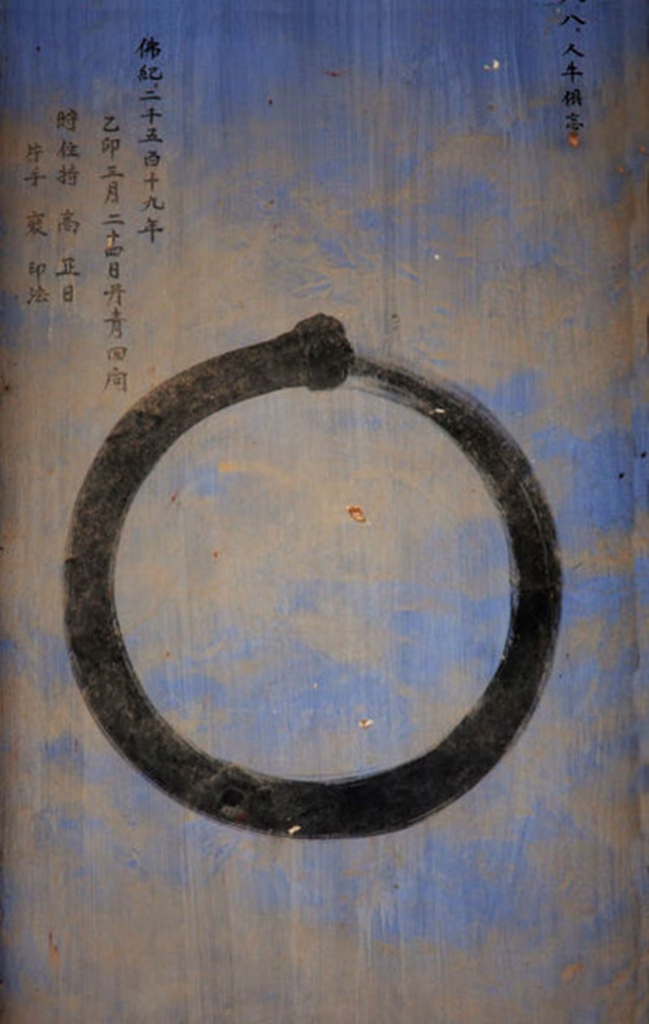
강진 백련사의 <십우도> 여덟 번째 그림 “인우구망(人牛俱忘)” — Photo Source: 우리문화신문, 2015.04.04
The simple circle is not an absence but a fullness-a symbol of freedom from grasping, wanting, or clinging.
When I first saw that circle, it brought back the same shock I felt years earlier when I heard that a friend had written only eight characters on his exam.
A Lesson That Stayed With Me
I am not a Buddhist, and I don’t live a monastic life. But the eighth Ox-Herding picture has stayed with me through the years as a quiet companion and a personal mirror.
It reminds me:
- to step back from the urge to possess or control
- to loosen my grip on things I desperately want to hold
- to find calm by letting go rather than accumulating more
- to seek clarity through simplicity, not excess
Just like the empty circle-and like the story of those eight characters-some of the deepest insights arrive in the simplest, most unadorned forms.
That lesson has woven itself into my life-into the way I think, create, and write.
And perhaps that is why I remain drawn to the Ten Ox-Herding Pictures after all these years: they speak quietly, yet hold a wisdom that continues to unfold.